Posted on October 21, 2026
 How Penn-Mar contributed to Maryland’s Technology First Celebration and the conversation about greater independence.
At Maryland’s August 2026 Technology First Celebration, Penn-Mar helped spotlight how assistive and enabling technologies can expand independence, choice, and inclusion for people with intellectual and developmental disabilities (IDD). Through presentations, video features, and testimonials, Penn-Mar shared practical examples of how telehealth and virtual reality can help the people we support access healthcare and explore employment.
The annual statewide event celebrates Maryland’s official designation in 2022 as a “Technology First State.” Maryland was the eighth U.S. state to adopt the approach, which encourages considering technology early in support planning for people with disabilities. It promotes person-centered approaches to help individuals live, work, and play in their communities with greater independence, safety, and choice.
The conference brought together technology vendors, state partners, and people with disabilities from across Maryland to explore technology solutions. The goal is to connect families and service providers with innovative tools that can improve daily life for people with IDD.
The theme of the August 2026 Technology First Celebration held in Columbia, MD, was “Technology Solutions: Building My Good Life.”
Allis Kensing, Penn-Mar’s Enabling Technology Manager, has attended the annual event since 2022. This year she was joined by Amie Newton, Enabling Technology Resource Coordinator, and Penn-Mar’s new Chief Technology Officer, Audra Hurd.
And for the first time, Penn-Mar was invited to deliver one co-presented session and two video contributions, sharing its expertise and experience with Assistive Technology (AT) products.
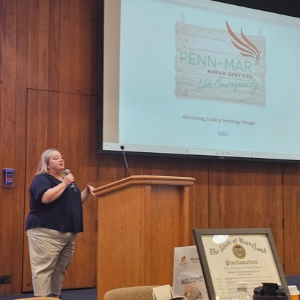
Allis and a colleague from SEEC (Seeking Equality, Empowerment, and Community for people with IDD) presented a session on “Assistive Technology: Not Just a Practical Solution, A Fundamental Right” to share how AT supports choice, independence, and community inclusion.
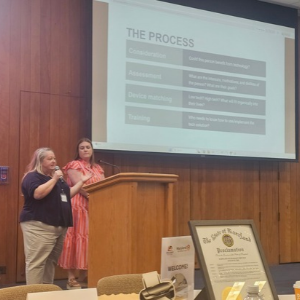 “AT is a human right, not a convenience,” said Allis. “The issue is not about ability, but an access gap for people with IDD. Technology is part of everyday life, with 95% of U.S. adults using the internet. Research has also found that less than 3% of people with IDD receiving Medicaid Home and Community-Based Services were projected to receive assistive technology services.” Ninety-five percent of U.S. adults now routinely use the internet, yet fewer than three percent of people with IDD receive supports to get help to access it, or to be considered to use the technology.”
The Maryland Technology First Task Force also invited Penn-Mar to share its experience piloting StationMD, a telehealth platform not yet available in Maryland. Penn-Mar Residential Supervisor Emily Finnegan produced and presented a short video featuring testimonials about the program’s impact.
Penn-Mar also presented a video showcasing how Virtual Reality (VR) technology, funded through the Maryland Works Grant, is being used to support employment exploration, skill development, and workforce readiness at an employment boot camp designed for transitioning students preparing to come into adult services. According to Allis, this technology is a great way for a person interested in getting a job to be virtually immersed in different job experiences to help them explore employment options and the skills needed to be successful.
Allis has built a big network with other Maryland providers and the Annual Technology First event provides an opportunity for her to meet with them in person and talk about “the trials and tribulations of using tech.” She describes it as “an exciting place to be to share a full day of discovery and inspiration.”
Allis emphasizes that technology will never take the place of traditional services to people with IDD.
“In our field of human services there will always be the need for human touch and presence,” she said. “Technology will improve the lives of the people we support and help make the jobs of the DSPs easier, but in the end, it is just another tool. It will never replace person-to-person interaction.”