Posted on October 8, 2026
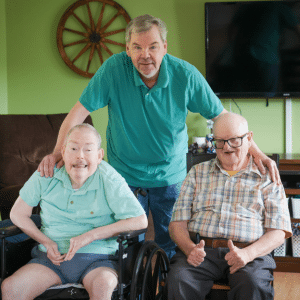 Single-story homes create an ideal setting for aging in place.
By Jackie Stevens
Penn-Mar Chief Operating Officer
A 2024 U.S. Centers for Disease Control and Prevention study puts life expectancy at 76.5 years for men and 81.4 years for women.
About 1 in 9 Americans age 65 and older are living with dementia.¹ People with intellectual and developmental disabilities (IDD) may also experience dementia as they age, with some research showing an increased risk among people with intellectual disabilities.² The risk is especially high for people with Down syndrome, with estimates suggesting that 50% or more will develop dementia due to Alzheimer’s disease as they age.³
This need is especially important at Penn-Mar. We currently provide residential services to 190 people, including 65 who are aged 60 or older and 40 between the ages of 50 and 60. For many people who receive residential services from Penn-Mar, these homes and communities remain an important part of their lives for decades. Our responsibility is to make sure their homes can continue to meet their needs as they age.
As people age and their cognitive or mobility needs change, Penn-Mar is reshaping its residential program so they can continue living in familiar communities, surrounded by people they know and trust.
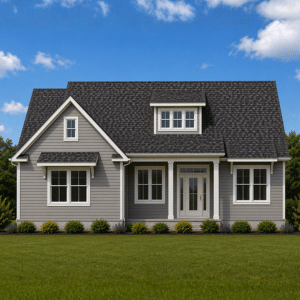
An example rendering of a one-story house.
Penn-Mar began studying these trends eight years ago, looking closely at which community homes could continue to meet residents’ needs as they grew older. That planning led to the Housing Transition Project, formally launched in 2021.
Through the project, Penn-Mar is gradually replacing two-story homes with accessible, one-story properties that better support people as they age. Proceeds from the sales of the existing homes will be used to purchase accessible one-story properties, and we will also build new homes, as needed, to meet the demand.
All of this is to ensure that the people we support will be able to continue living safely, independently, and comfortably in their own homes and communities with the support team they have come to know and rely on.
Penn-Mar owns all of its residential homes, giving us greater flexibility to modify or replace properties as residents’ needs change.
Penn-Mar has adapted existing homes whenever possible, even converting dining rooms and offices into first-floor bedrooms so housemates could continue living together. But as cognitive and mobility needs change, modifications can only go so far. The Housing Transition Project identified 16 two-story homes, seven in Pennsylvania and nine in Maryland to be replaced or reconfigured as accessible, one-story residences.
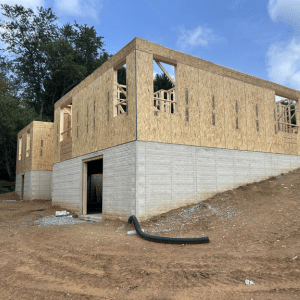
A progress photo of the one-story (plus a basement for storage only) house in White Hall, MD.
Just in the past two years, we have sold four homes to help us purchase one-story homes. In July, we broke ground at a home in White Hall, MD, the eighth of the 17 homes on the House Transition Project list. When it is completed in December, it will be a fully accessible single-story home (with a basement for storage only) where residents will benefit from its open floor plan for wheelchairs and walkers, a smart kitchen with assistive technology, walk-in showers, and wide doorways.
Significant changes in the real estate market mean that finding the right property is more challenging today than when Penn-Mar expanded its residential program in the late 1990s and early 2000s.
Homes in Baltimore and York County are significantly more expensive, with many priced between $600,000-700,000, not including the tens-of-thousands of dollars needed for accessibility upgrades and to meet licensing requirements. New construction projects are also difficult. It took 18 months to get the necessary permits to put a shovel in the ground at Shane Valley.
Despite the many challenges along the way, we have reached the halfway point of our 17 home transitions.
Through every transition, Penn-Mar’s priority is to preserve what matters most: the relationships and sense of home people have built over time. Their needs may change as they grow older, but that shouldn’t mean leaving behind the people and community that are part of their lives.
The Housing Transition Project is helping make sure their homes can change with them.
Footnotes: